
- Home
- Products
- Solutions
- About
- Service
- Sustainability
- News
- Contact Us

Views: 0 Author: Site Editor Publish Time: 2026-09-16 Origin: Site


Material selection inside a semiconductor crystal growth furnace is not simply a question of which carbon material withstands the highest temperature. Crucibles, heaters, guide tubes, fasteners, support rings, and insulation layers perform very different thermal, electrical, and mechanical functions. The practical Carbon-Carbon Composite vs Graphite decision therefore depends on load direction, thermal conductivity, electrical behavior, thermal cycling, dimensional accuracy, operating atmosphere, contamination requirements, and maintenance strategy. In this comparison, graphite primarily refers to fine-grain isotropic graphite used for high-temperature furnace components, while carbon-carbon composite refers to carbon-fiber-reinforced carbon materials intended for demanding structural applications at elevated temperatures.
Selection Factor | Carbon-Carbon Composite | Isotropic Graphite |
|---|---|---|
Basic structure | Carbon fibers reinforced with a carbon matrix | Fine-grain bulk graphite with relatively uniform directional properties |
Strength-to-weight ratio | Generally higher and suitable for lightweight structures | Lower and more susceptible to brittle fracture under unfavorable loading |
High-temperature structural duty | Well suited to loaded frames, rings, fasteners, and thin structural components | Suitable for compact components where brittle fracture risk is controlled |
Thermal-property uniformity | Can vary substantially with fiber orientation | More uniform because of isotropic material structure |
Thermal shock | Strong resistance supported by fiber reinforcement | Good resistance but more sensitive to stress concentration |
Precision machining | Machinable, but reinforcement architecture requires additional attention | Highly suitable for detailed precision machining |
Typical furnace role | Structural and load-bearing components | Crucibles, heaters, thermal-field components, and precision parts |
Initial cost | Often higher because of composite manufacturing and fabrication complexity | Often more economical for conventional machined components |
The main conclusion is that neither material should automatically replace the other throughout the entire hot zone. Carbon-carbon composite is generally most valuable where structural strength, low weight, and resistance to brittle failure solve a real operating problem. Isotropic graphite remains highly useful where precise machining, predictable electrical behavior, relatively uniform thermal performance, and controlled component geometry are more important.
The first major difference in Carbon-Carbon Composite vs Graphite is internal architecture. Carbon-carbon composite contains reinforcing carbon fibers inside a carbon matrix. The fibers carry mechanical loads and help prevent cracks from propagating through the material in the same way they can through an unreinforced brittle body. Depending on the reinforcement architecture, properties can vary between the fiber direction, through-thickness direction, axial direction, or circumferential direction.
This anisotropic behavior can be an advantage when a furnace component is designed around a known load path. Rings, cylinders, support plates, frames, and fastening components can potentially use fiber orientation to improve structural performance. However, orientation must also be considered when evaluating thermal conductivity, dimensional movement, machining, joints, holes, and localized stresses.
SIAMC's Carbon-Carbon Composite Materials provide a material platform for demanding high-temperature applications where reinforcement and low structural mass are important considerations.
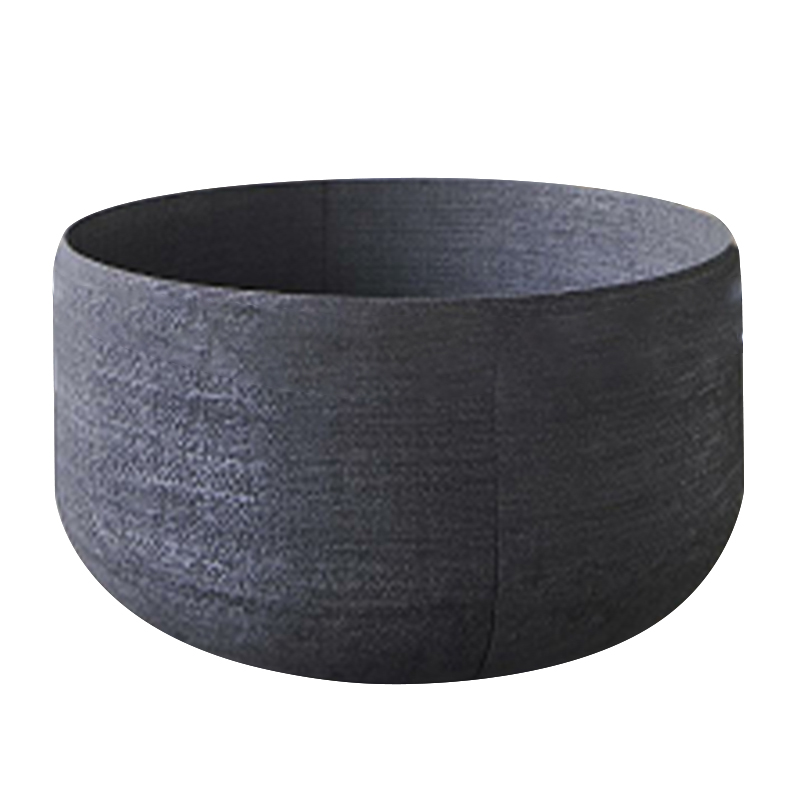
Fine-grain isotropic graphite has a different structure. It is a bulk graphite material designed to provide comparatively uniform properties in different directions. That characteristic is valuable for semiconductor crystal growth furnaces because many components depend on predictable heat transfer, electrical resistance, machining behavior, and dimensional response.
For heaters, crucibles, thermal shields, precision rings, and other components with complex grooves, slots, controlled wall thicknesses, or exact mating surfaces, High Purity Isotropic Graphite can therefore offer greater manufacturing convenience and dimensional predictability.
The structural difference also changes the way engineers should read material data. A single tensile-strength or thermal-conductivity number is often insufficient for C/C because orientation matters. For isotropic graphite, directional variation is generally less dominant, making design calculations and machining allowances more straightforward.
Mechanical performance is one of the clearest areas where carbon-carbon composite and isotropic graphite differ. Graphite retains useful properties at elevated temperatures under suitable non-oxidizing conditions, but it remains a brittle material. Sharp corners, threaded sections, thin walls, impact during installation, excessive fastening force, bending stress, or local stress concentration can initiate cracking.
Carbon-carbon composite behaves differently because the reinforcing fibers continue carrying load when small regions of the carbon matrix become damaged. This does not make C/C immune to failure, but it can make the material more tolerant of mechanical loading, impact, and repeated thermal cycling than a comparable monolithic graphite structure.
The advantage is particularly relevant for large support rings, beams, brackets, trays, structural cylinders, fixtures, and selected fasteners. These components may experience bending or tensile loads rather than simple compression. A graphite part that performs adequately under compression may become vulnerable when the same geometry is exposed to bending, assembly stress, or repeated handling.
Weight is another design consideration. Carbon-carbon composite can provide useful structural performance at relatively low mass. In large hot zones, reducing structural mass may simplify component handling and reduce the load transmitted to surrounding supports. It may also reduce the amount of structural material being heated and cooled, although the actual influence on furnace cycle time depends on the complete thermal-field design rather than one component alone.
Graphite should not automatically be replaced in every mechanical position. Thick, compact parts with predominantly compressive loading can remain highly practical. If the graphite component is inexpensive, easy to machine, easy to replace, and does not suffer recurring mechanical failure, a C/C conversion may provide limited economic benefit.
The most useful selection question is therefore not “Which material is stronger?” but “What actually causes this component to fail?” If the current graphite part fails because of cracking, thread damage, impact, bending, handling, or thermal cycling, C/C deserves serious consideration. If the limiting factor is oxidation, surface erosion, contamination, or normal consumable wear, greater structural strength may not extend useful life.
Thermal conductivity is critical in crystal growth furnaces because temperature gradients directly influence hot-zone performance. Isotropic graphite is useful where relatively uniform heat conduction is required around a machined component. Carbon-carbon composite can also conduct heat efficiently, but its conductivity may vary substantially depending on fiber orientation, density, architecture, and processing.
This means a Carbon-Carbon Composite vs Graphite comparison should not rely on one room-temperature conductivity value. Designers should evaluate thermal conductivity at the actual operating temperature and in the direction heat must travel through the component. This is particularly important for guide cylinders, heat shields, support structures located close to the heater, and components that influence axial or radial thermal gradients.
Directional conductivity can sometimes be intentionally used in a C/C design. However, substituting C/C for graphite without considering orientation can also create a different heat-flow path and alter the thermal field. Structural benefits therefore need to be evaluated together with thermal behavior.
Both carbon-carbon composite and graphite have relatively low thermal expansion compared with many metallic furnace materials. Low expansion helps reduce thermally induced dimensional change, but expansion coefficient alone does not determine thermal-shock resistance.
C/C generally has an advantage where rapid temperature changes occur together with mechanical loading because fiber reinforcement helps distribute stress and limits brittle crack propagation. Isotropic graphite also provides good thermal-shock performance, but its monolithic structure makes local stress concentration more important.
For example, a graphite component with sharp internal corners or a heavily constrained joint may experience high local stress even if the bulk material has favorable thermal expansion characteristics. Smooth transitions, reasonable wall thicknesses, suitable clearances, and appropriate fastening strategies can therefore be as important as the material itself.
Carbon-based materials are particularly useful at high temperature under suitable vacuum or inert-gas conditions. This is one reason graphite and carbon composites are widely considered for High-Temperature Furnace Applications, including crystal growth and related thermal-processing equipment.
Neither material should be considered oxidation-proof. If oxygen enters the hot zone while a carbon component is at elevated temperature, oxidation can progressively consume the material. For graphite, this may change dimensions, surface condition, mechanical strength, and electrical resistance. For C/C, oxidation can attack both the carbon matrix and the reinforcing fibers, eventually reducing load-bearing capability.
Oxidation behavior depends on operating temperature, oxygen partial pressure, gas flow, porosity, surface condition, exposure time, material grade, and the presence of any protective surface treatment. Furnace leak control and atmosphere management can therefore affect carbon-component lifetime as much as nominal material temperature capability.
This is especially important when comparing service life. A C/C support that resists mechanical cracking may still deteriorate if oxygen repeatedly enters the hot zone. Likewise, changing graphite grade without addressing a persistent atmosphere problem may not solve premature component loss.
Precision machining is one of the strongest advantages of fine-grain isotropic graphite. The material can be machined into complicated profiles, grooves, slots, holes, resistance paths, mating surfaces, and controlled wall thicknesses. For heaters and thermal-field components, this capability is particularly valuable because small dimensional changes may influence electrical resistance, heat generation, local temperature distribution, or assembly clearance.

Carbon-carbon composite is also machinable, but the reinforcing fibers change the machining process. Drilling, milling, cutting edges, thin walls, and threaded features can expose or interrupt fibers. Edge damage, fiber pull-out, local delamination, and tool wear require additional attention. Extremely detailed features may also reduce the structural advantage of the reinforcement if too many load-carrying fibers are cut.
That does not mean C/C offers less design flexibility overall. Its advantage appears in a different area. Carbon-carbon composite can be attractive for large rings, plates, frames, cylinders, guide structures, and other components where a conventional graphite design might require greater thickness to reduce the risk of brittle fracture.
SIAMC's CFC Composite Components can therefore be considered where low structural weight, mechanical durability, and high-temperature operation are more important than extremely intricate machining.
Dimensional accuracy should also be evaluated over the complete service cycle rather than only at room temperature. A precisely machined component may still perform poorly if the assembly constrains thermal movement, creates excessive joint stress, or changes shape under load. For C/C, orientation-dependent expansion and stiffness should be included in the design. For graphite, local brittleness and stress concentration deserve additional attention.
Carbon-carbon composite does not automatically provide a longer service life than graphite. Its greatest advantage appears when graphite components are limited by mechanical cracking, thermal cycling, impact during furnace maintenance, thin-wall fragility, or insufficient strength for the required geometry.
If a component is replaced because of oxidation, contamination, surface reaction, process deposition, chemical interaction, or intentional consumable wear, switching to C/C may provide a much smaller improvement. Identifying the actual replacement mechanism is therefore essential before changing materials.
Maintenance frequency also depends on the role of the component. A structural support buried deep inside the hot zone is expensive to replace because accessing it can require extensive furnace disassembly. Improving the lifetime of this type of component can create significant operational value. A simple graphite spacer positioned near the outer assembly may be inexpensive and quick to replace, making a higher-cost composite alternative less attractive.
Component function should drive the final Carbon-Carbon Composite vs Graphite decision. The following comparison provides a practical starting point for semiconductor crystal growth furnaces rather than a universal material specification.
Furnace Component | Typical Starting Choice | Why | Key Selection Check |
|---|---|---|---|
Crucible | Isotropic graphite | Precision machining and predictable thermal geometry | Confirm purity, process chemistry, dimensions, thermal gradients, and expected service interval |
Heater | Isotropic graphite | Controlled electrical-resistance geometry and machinability | Evaluate resistivity, current path, contacts, cross-section, power supply, and temperature distribution |
Guide tube or guide cylinder | C/C or graphite | C/C favors lightweight structural shells; graphite favors precise thermal geometry | Determine whether mechanical support or thermal-field control is the dominant function |
Fasteners | C/C for highly loaded joints | Fiber reinforcement can reduce vulnerability to brittle mechanical fracture | Check thread design, preload, fiber orientation, electrical interaction, and maintenance requirements |
Support rings and frames | Carbon-carbon composite | High strength-to-weight ratio and good resistance to repeated loading | Check load path, unsupported span, stiffness, joints, and fiber direction |
Structural plates and trays | Carbon-carbon composite | Useful for thin, large, or mechanically loaded structures | Compare permissible deflection, thickness, stiffness, and machining requirements |
Thermal insulation | Graphite felt | Designed to reduce heat transfer rather than carry major structural loads | Confirm insulation thickness, purity, installation arrangement, gas flow, and mechanical protection |
Isotropic graphite is usually the more logical starting material for a crystal growth crucible because precision geometry, thermal behavior, machinability, and process compatibility may be more important than maximum structural strength. A crucible can strongly influence heat flow and process stability, so replacing graphite with C/C should never be based only on weight or mechanical strength.
Graphite is also a practical choice for many resistance heaters because heater geometry can be precisely machined to achieve the required electrical resistance and heat-generation pattern. A C/C heater cannot be treated as a direct replacement without evaluating resistivity, fiber orientation, current distribution, electrical contacts, cross-sectional geometry, and thermal-field consequences.
Guide structures require a more balanced decision. If the component primarily controls radiation and thermal distribution, the predictable geometry and thermal properties of graphite may be beneficial. If it is large, thin-walled, repeatedly handled, or mechanically loaded, C/C may provide a more attractive structural solution.
Fasteners are an area where C/C can offer practical value because brittle graphite threads can be vulnerable to excessive tightening, impact, misalignment, or repeated disassembly. Carbon-carbon composite can improve mechanical tolerance, although thread geometry, fiber orientation, preload, contact surfaces, and electrical interaction still need to be considered.
C/C is particularly attractive for large support rings, frames, beams, trays, and structural plates. These components benefit directly from low weight and reinforcement because their primary job is mechanical rather than electrical. The material can be especially useful where a graphite structure would otherwise need to be made thick and heavy to reduce fracture risk.
Insulation should be treated as a separate material function. Graphite Felt Insulation is intended to reduce heat loss rather than replace dense graphite heaters or C/C structural parts. Selecting insulation based on thermal conductivity, thickness, purity, gas flow, and installation arrangement is more appropriate than comparing it directly with load-bearing carbon materials.
Yes. In many crystal growth furnaces, combining the two materials is more rational than trying to use a single carbon material for every component. A hybrid hot zone can use graphite where electrical resistance, precise machining, controlled thermal conduction, or process-contact geometry is critical, while C/C carries mechanical loads and improves the durability of structural components.
A practical arrangement may use isotropic graphite for the crucible and resistance heater, carbon-carbon composite for support rings, frames, selected guide structures, and fasteners, and graphite felt around the outer thermal field for insulation.
The advantage of this approach is functional separation. Structural components do not have to be optimized around the same criteria as heaters or crucibles. Durable C/C components can remain in the furnace for longer periods while graphite parts that serve thermal, electrical, or consumable functions are replaced according to their actual condition.
However, combining carbon-carbon composite and graphite requires careful interface design. Different thermal and structural behavior can affect joint loads, heat flow, electrical paths, and maintenance procedures.
Thermal movement: Joints should allow appropriate expansion and contraction without creating unnecessary restraint during heating and cooling.
Fiber orientation: C/C properties vary with reinforcement direction, so both mechanical loading and thermal conduction need to be considered.
Electrical interaction: Conductive structural parts must not create unintended current paths, contact heating, or electrical bypasses around the intended heater circuit.
Thermal-field influence: Replacing graphite with C/C can change heat conduction, radiation conditions, component mass, and local temperature distribution.
Purity requirements: Every material exposed to the hot zone should satisfy the contamination requirements of the specific crystal growth process.
Maintenance sequence: Replaceable graphite components should be removable without damaging longer-life C/C supports.
Oxidation exposure: Both materials require suitable atmosphere control at high temperature.
One valuable design strategy is to separate structural lifetime from consumable lifetime. If a graphite support fails much earlier than the heater or crucible because of mechanical cracking, replacing the support with a suitable C/C structure may reduce unnecessary hot-zone disassembly. Conversely, there is little benefit in converting a graphite component to C/C if the component must already be replaced because of process-related surface consumption.
The practical choice between carbon-carbon composite and isotropic graphite depends on what each component must accomplish inside the crystal growth furnace. Isotropic graphite is generally well suited to precision crucibles, heaters, and thermal-field components where dimensional accuracy, electrical behavior, and predictable heat transfer are critical. Carbon-carbon composite is especially valuable for lightweight load-bearing structures, fasteners, rings, frames, and components exposed to repeated mechanical and thermal cycling. Graphite felt can provide the separate insulation function. A hybrid hot-zone design often provides a better balance of thermal control, mechanical reliability, maintenance frequency, and lifecycle cost than using one material throughout the furnace. SIAMC is a manufacturer of specialty graphite and carbon-based materials for semiconductor and high-temperature furnace applications.
For many structural furnace applications, carbon-carbon composite offers a higher strength-to-weight advantage and greater tolerance of cracking because carbon fibers reinforce the carbon matrix. Actual performance still depends on fiber architecture, material grade, component geometry, load direction, and operating conditions. Graphite can remain effective where loading is mainly compressive and brittle fracture is properly controlled.
Both materials can perform well under high-temperature cycling, but carbon-carbon composite generally provides an advantage where rapid temperature changes are combined with mechanical loading. Fiber reinforcement helps limit brittle crack propagation. Isotropic graphite remains suitable when temperature gradients, geometry, and mechanical restraint are carefully controlled.
No. A heater is an electrical component as well as a structural component. Changing material can affect resistivity, current distribution, contact resistance, heating power, cross-sectional requirements, and temperature uniformity. C/C fiber orientation can introduce additional directional behavior, so electrical and thermal validation is required before substitution.
Its fine-grain structure and relatively uniform properties make it suitable for machining detailed geometries and maintaining controlled dimensions. These characteristics are particularly useful for crucibles, resistance heaters, rings, and thermal-field components whose geometry can directly influence furnace performance.
No. C/C is most likely to improve service life when graphite fails because of brittle fracture, mechanical loading, handling damage, thin-wall weakness, or severe thermal cycling. If oxidation, chemical interaction, contamination, surface erosion, or normal process consumption controls component life, changing to C/C may provide much less benefit.
Confirm operating temperature, vacuum or gas atmosphere, mechanical load, load direction, electrical function, required thermal conductivity, dimensional tolerances, thermal expansion constraints, purity requirements, component geometry, joint design, expected replacement interval, maintenance procedure, and surrounding hot-zone materials. These factors provide a much more reliable basis for material selection than comparing maximum temperature or purchase price alone.


