
- Home
- Products
- Solutions
- About
- Service
- Sustainability
- News
- Contact Us

Views: 0 Author: Site Editor Publish Time: 2025-06-12 Origin: Site


The demands of modern semiconductor manufacturing and precision machining are among the most rigorous in industrial production. Whether producing the latest generation of microchips or crafting intricate molds and tools via electrical discharge machining (EDM), the materials involved must perform flawlessly under extreme conditions. High temperatures, reactive chemicals, plasma environments, and the need for micron-level precision push conventional materials to their limits. In these demanding settings, fine grained graphite emerges as an essential material, offering a combination of purity, strength, and stability that few alternatives can match.
Fine grain graphite’s tightly packed microstructure, low impurity content, and excellent thermal and electrical properties make it the material of choice for components such as semiconductor susceptors, wafer boats, and EDM electrodes. This article explores the critical roles fine grained graphite plays in these industries, the unique advantages it offers, and why it continues to outperform other materials in applications demanding exceptional precision and durability.
Semiconductor manufacturing is a complex sequence of processes including chemical vapor deposition (CVD), plasma-enhanced chemical vapor deposition (PECVD), etching, diffusion, and ion implantation. These steps occur in high-temperature, vacuum, and plasma-rich environments, where materials are exposed to corrosive gases like fluorine and chlorine compounds. The slightest contamination or component degradation can cause defects in the silicon wafers, leading to reduced device yields and increased costs.
Fine grained graphite stands out due to its exceptional purity, dimensional stability, and chemical resistance, all of which are paramount in semiconductor applications.
Susceptors: Susceptors are used to absorb and uniformly distribute heat during deposition and diffusion processes. The uniform thermal conductivity and high temperature resistance of fine grain graphite ensure stable thermal profiles, critical for uniform wafer processing.
Wafer Boats and Carriers: These components hold silicon wafers securely during various high-temperature processes. Fine grained graphite’s low coefficient of thermal expansion prevents warping and distortion, maintaining wafer alignment and minimizing breakage risks.
Insulation Parts and Shielding Plates: Protecting sensitive components from plasma and preventing contamination requires materials with low outgassing and high erosion resistance. The dense, isotropic structure of fine grain graphite limits particle shedding, helping maintain ultra-clean environments.
Semiconductor fabrication demands materials with:
High Purity: Fine grained graphite typically features ash content below 5 parts per million (ppm), which minimizes contamination risks that could otherwise damage delicate semiconductor features.
Dimensional Stability: Repeated thermal cycling in vacuum or plasma environments demands materials with low thermal expansion and excellent mechanical stability, properties inherent to fine grained graphite.
Corrosion Resistance: Resistance to halogen plasma and corrosive etchants ensures longer service life and less frequent replacement of graphite components.
The combination of these features makes fine grained graphite indispensable in advanced semiconductor manufacturing.
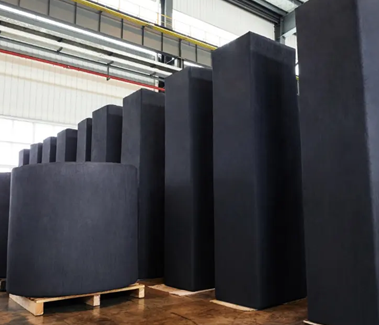
EDM is a machining process that uses controlled electrical discharges to remove material from a workpiece, allowing the creation of highly intricate shapes and complex geometries that are difficult or impossible to achieve with conventional machining. EDM electrodes play a vital role in the precision and surface finish of the final product.
Fine grained graphite offers several benefits that directly address the challenges faced in EDM operations:
Superior Wear Resistance: The fine, uniform microstructure enhances mechanical strength and reduces erosion of electrodes during discharge cycles, extending electrode lifespan.
Improved Surface Finish: The homogeneous nature of fine grain graphite allows for smoother, more consistent electrode surfaces, resulting in better machining accuracy and reduced post-processing requirements.
Reduced Dust and Contamination: EDM processes can generate graphite dust, which, if excessive, may contaminate the machining environment and impair equipment. Fine grained graphite produces less dust, maintaining cleaner conditions and reducing maintenance.
Machinability for Complex Shapes: Its fine structure allows precise machining of electrodes with intricate features, enabling the production of complex components with tight tolerances.
Longer electrode life and improved machining quality reduce downtime and scrap rates, translating into cost savings and increased production efficiency. For industries relying on EDM—such as aerospace, automotive, and mold manufacturing—fine grained graphite is a critical enabler of both quality and throughput.
Unlike coarse graphite with larger, uneven grains, fine grained graphite exhibits an isotropic structure where mechanical, thermal, and electrical properties are uniform in all directions. This uniformity enhances reliability and consistency, vital for precision applications.
Fine grained graphite is produced with rigorous control over raw materials and manufacturing processes to achieve ultra-low ash content—often less than 5 ppm. This purity level significantly reduces contamination risks in sensitive manufacturing processes, such as semiconductor fabrication.
In environments where cleanliness is paramount, the dense, well-bonded particles of fine grain graphite minimize particle release during handling and operation. This reduces the risk of contamination in vacuum chambers, plasma reactors, and machining centers, helping maintain product quality and process integrity.
Fine grained graphite provides excellent thermal conductivity, ensuring uniform heat distribution in components like susceptors and wafer carriers. Its electrical conductivity is also critical for EDM electrodes, enabling efficient, controlled discharge machining.
Several specialized graphite grades are engineered for semiconductor and EDM applications, featuring optimized grain size, purity, density, and strength. Suppliers like SIAMC Advanced Materials Co., Ltd. offer custom fine grain graphite products tailored to specific process requirements.
Semiconductor manufacturers and precision machining facilities consistently report higher yields, lower downtime, and improved component lifespans when switching to fine grained graphite materials. The demand for increasingly smaller semiconductor nodes and complex EDM electrode geometries further drives the adoption of fine grain graphite.
With the continuous push toward miniaturization and more complex device architectures in the semiconductor industry, fine grain graphite’s role is expanding. Additionally, advancements in EDM technology, including high-speed and micro-EDM processes, rely heavily on the improved machinability and durability of fine grain graphite.
Fine grained graphite has proven itself as a vital material in the high-stakes world of semiconductor manufacturing and electrical discharge machining. Its superior mechanical strength, dimensional stability, purity, and thermal properties make it uniquely suited to environments that demand precision and durability under extreme conditions. For semiconductor susceptors, wafer boats, and plasma-resistant components, as well as for EDM electrodes requiring fine surface finishes and long life, fine grain graphite stands as the optimal choice.
For manufacturers and engineers seeking to maximize yield, reduce contamination, and improve process stability, adopting fine grained graphite components is a strategic investment. Companies like SIAMC Advanced Materials Co., Ltd. specialize in producing high-quality fine grain graphite tailored for these exacting applications. To learn more about their product offerings or to discuss your specific needs, consider contacting SIAMC for expert guidance and advanced material solutions.


