
- Home
- Products
- Solutions
- About
- Service
- Sustainability
- News
- Contact Us

Views: 0 Author: Site Editor Publish Time: 2026-10-01 Origin: Site


Short answer: the difference begins with how the graphite is formed. Isostatic graphite is compacted by pressure applied from multiple directions, which promotes a fine, relatively uniform structure and more consistent properties in different directions. Extruded graphite is pushed through a die, which creates a preferred grain orientation and therefore more direction-dependent, or anisotropic, behavior. That structural difference affects strength, conductivity, machining behavior, available shapes and sizes, application fit, and cost.
| Comparison point | Isostatic graphite | Extruded graphite |
|---|---|---|
| Primary forming method | Powder is compacted under pressure applied uniformly from multiple directions, typically by cold isostatic pressing. | A prepared carbon/graphite mixture is forced through a die to create a continuous profile. |
| Property directionality | Designed for relatively uniform, near-isotropic behavior in different directions. | Usually anisotropic; properties differ parallel and perpendicular to the extrusion direction. |
| Typical grain character | Commonly fine or ultrafine grain, depending on grade. | Commonly coarser grain than isostatic grades. |
| Mechanical behavior | Generally selected where consistent strength, dimensional stability, and complex loading matter. | Can perform well where the main stress direction and material orientation are understood. |
| Thermal/electrical behavior | More uniform from one direction to another. | More direction-dependent; some extruded grades can provide higher thermal and electrical conductivity. |
| Precision machining | Fine, homogeneous grades are well suited to detailed machining and consistent surface quality. | Well suited to many general-purpose machined parts, but orientation should be considered in the design. |
| Typical selection logic | Preferred when uniformity, purity, fine features, predictable thermal response, or multidirectional loading are critical. | Preferred when cost efficiency, long profiles, larger section sizes, or directional performance are more important. |
These are material-class trends, not universal grade specifications. Actual density, grain size, strength, resistivity, thermal conductivity, ash content, and maximum available dimensions should always be checked on the supplier's grade data sheet.
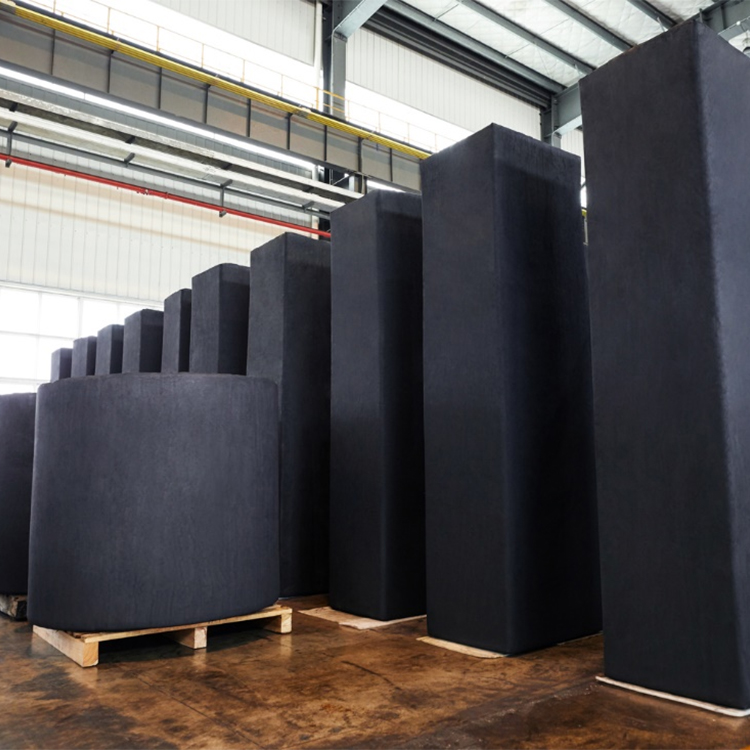
For isostatic graphite, a carefully prepared fine carbon powder is placed in a flexible mold or containment system and compacted by fluid pressure. Because pressure acts from multiple directions, the forming step avoids the strong one-axis particle alignment associated with extrusion. After forming, the material goes through controlled thermal processing, including baking and graphitization, with additional purification or treatment depending on the grade.
The practical result is a graphite body with comparatively homogeneous microstructure and small differences between measurement directions. This is why isostatic graphite is widely associated with precision, high-purity, and high-temperature applications where repeatability is more important than maximizing output from a continuous forming process.
Extruded graphite starts from a carbonaceous mixture that is pushed under pressure through a shaped die. The material flow during extrusion tends to align particles and pores along the extrusion direction. That alignment is retained through later heat treatment and creates an anisotropic material.
Anisotropy is not automatically a disadvantage. If the component geometry and main stress, heat-flow, or current-flow direction are known, a designer can use the directional behavior intentionally. Extrusion is also efficient for producing long sections and repeatable profiles.
Graphite crystals themselves are highly anisotropic at the microscopic level. What engineers usually mean when they describe a bulk graphite grade as “isotropic” is that the manufacturing process distributes many grains in a way that makes the measured bulk properties comparatively similar in different directions.
With extruded graphite, the forming direction is important. Mechanical strength, thermal expansion, electrical resistivity, and thermal conductivity can differ depending on whether a specimen is measured parallel or perpendicular to the extrusion axis. Drawings and machining plans should therefore preserve the intended material orientation.
Isostatic grades are commonly produced from finer powders than extruded grades. A fine, homogeneous grain structure can support small machined details, sharper edges, thin walls, and more consistent surface quality. This is one reason isostatic graphite is frequently considered for semiconductor tooling, precision molds, EDM electrodes, and other components where local defects or large pores can affect performance.
Extruded graphite is commonly coarser-grained. That does not make it a low-quality material; it means the grade is optimized for a different combination of manufacturability, size, cost, conductivity, and mechanical requirements. Many furnace, metallurgical, heat-treatment, and general industrial applications do not require the fine microstructure of a premium isostatic grade.

Because fine-grain isostatic graphite has a more uniform structure, it is generally chosen when a component must maintain predictable strength and dimensions regardless of orientation. This is particularly useful for parts with complex geometry, multiple stress directions, thermal cycling, or tight machining tolerances.
Extruded graphite can still offer excellent service life when the grade and orientation are matched to the part. Engineers should pay close attention to directional test values rather than relying on a single “strength” number. A value measured parallel to extrusion may not represent performance across the grain.
Both material classes conduct heat and electricity, but the performance pattern is different. Isostatic graphite is valued for consistency: thermal and electrical properties are comparatively uniform through different directions. That can help maintain even temperature distribution in susceptors, fixtures, heaters, furnace components, and other precision thermal systems.
Extruded graphite can show stronger directional conductivity. SGL Carbon notes that extruded graphite generally has coarser grain and lower strength than isostatic graphite, but can have higher thermal and electrical conductivity. Whether that is an advantage depends on the component design. A directional heat-flow path can benefit from it; a part that requires uniform behavior in all axes may not.
Purity is grade-specific rather than determined only by the forming method. Both material types can be processed for demanding environments, but fine-grain isostatic graphite is especially common in applications where contamination control is critical, such as semiconductor and photovoltaic manufacturing.
SIAMC states that its fine-grain high-purity isotropic graphite combines fine grain and high strength with thermal shock resistance, corrosion resistance, electrical and thermal conductivity, and that low-ash material down to 5 ppm is available. When specifying a high-purity component, buyers should still define the required impurity limit, test method, purification state, and whether coating or additional surface treatment is needed.
Graphite is readily machinable compared with many high-temperature ceramics, but microstructure strongly affects what can be achieved reliably. Fine-grain isostatic graphite is usually a better starting point for intricate channels, thin ribs, small holes, fine electrode details, and smooth mold surfaces because the material structure is more homogeneous at the scale of the feature.
Extruded graphite remains practical for many machined components, especially larger or simpler geometries. The key is to communicate the extrusion direction to the machining team so that critical surfaces and load-bearing features are positioned appropriately.
| Application need | Material more commonly considered | Why |
|---|---|---|
| Semiconductor and photovoltaic process parts | Isostatic graphite | Fine grain, high-purity options, dimensional consistency, and predictable multidirectional behavior. |
| Precision EDM electrodes and molds | Isostatic graphite | Fine microstructure supports detailed machining and controlled surface finish. |
| Complex high-temperature fixtures or susceptors | Isostatic graphite | Uniform thermal and mechanical response can reduce orientation-related variability. |
| Long rods, bars, profiles, or general furnace components | Extruded graphite | Efficient continuous forming and useful directional properties. |
| Large, cost-sensitive industrial components | Often extruded or another molded grade | Performance requirements may not justify a fine-grain isostatic material. |
Choose an isostatic grade when: the part has complex geometry; loading or heat flow occurs in several directions; tight tolerances and fine surface finish matter; high purity is important; or consistent properties across the block are a priority.
Choose an extruded grade when: the component is long or profile-based; the primary load or conductivity direction is known; larger or simpler parts are needed; or cost efficiency matters more than near-isotropic behavior.
The best selection is made from the finished component requirements, not from the material name alone. A practical graphite specification should include part dimensions, drawing tolerances, operating temperature and atmosphere, mechanical load direction, thermal cycling, electrical requirements, target purity or ash level, surface-finish needs, and any coating or purification requirements.
SIAMC Advanced Materials Co., Ltd. was founded in 2007 and operates production bases in Huzhou, Zhejiang, and Yinchuan, Ningxia. The company supplies specialty graphite and carbon-based materials for applications including clean and renewable energy, semiconductor manufacturing, industrial furnaces, and precision molding. Its listed services include precision machining, material purification, surface treatment, inspection, and testing.
For projects where isostatic graphite is the better fit, SIAMC offers fine-grain high-purity isotropic graphite and machined graphite solutions. Material selection should be based on the exact service conditions and the grade data required by the component drawing rather than on a generic comparison alone.
No. Isostatic graphite offers more uniform properties and usually a finer structure, but extruded graphite can be more economical and may be preferable for long profiles, large general-purpose parts, or applications that benefit from directional conductivity.
The extrusion process forces the carbon mixture through a die. Material flow aligns particles and pore structure along the extrusion direction, so properties measured parallel to the extrusion axis differ from those measured perpendicular to it.
Its fine, homogeneous structure and reduced directionality make it suitable for detailed machining, tight dimensional control, and components exposed to multidirectional thermal or mechanical loads.
Not automatically. Purity depends on the raw materials and purification process. However, high-purity isostatic grades are widely available for semiconductor, photovoltaic, and other contamination-sensitive applications. SIAMC states that 5 ppm ash material is available in its fine-grain high-purity isotropic graphite range.
Provide the component drawing, dimensions, tolerances, operating temperature, atmosphere, load direction, thermal cycling conditions, electrical or thermal requirements, purity target, surface-finish requirements, expected quantity, and any purification or coating needs.
SIAMC provides specialty graphite materials together with machining, purification, surface treatment, inspection, and testing services. Share your drawing and operating requirements so the material can be evaluated against the actual application.
Contact SIAMC | View Fine-Grain High-Purity Isotropic Graphite


